
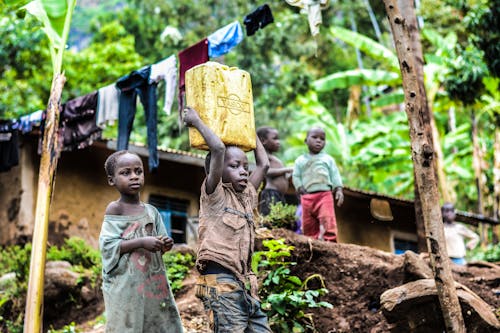
From the comfort of their plush offices and five to 6 figure salaries, self-appointed NGOs often denounce child labor as their employees rush from one five-star hotel to a different, $3000 subnotebooks and PDA’s in hand. The hairsplitting distinction made by the ILO between “child work” and “child labor” conveniently targets impoverished countries while letting its budget contributors – the developed ones – off-the-hook.
Reports regarding child labor surface periodically. Children crawling in mines, faces ashen, body deformed. The agile fingers of famished infants weaving soccer balls for his or her more privileged counterparts within the USA. Tiny figures huddled in sweatshops, toiling in unspeakable conditions. it's all heart-rending and it gave rise to a veritable not-so-cottage industry of activists, commentators, legal eagles, scholars, and opportunistically sympathetic politicians.
Ask the denizens of Thailand, Sub-Saharan Africa, Brazil, or Morocco, and that they will tell you ways they regard this altruistic hyperactivity – with suspicion and resentment. Underneath the compelling arguments lurks an agenda of trade protectionism, they wholeheartedly believe. Stringent – and expensive – labor and environmental provisions in international treaties could be a ploy to debar imports supported cheap labor and therefore the competition they wreak on well-ensconced domestic industries and their political stooges.
This is especially galling since the sanctimonious West has amassed its wealth on the broken backs of slaves and youngsters. The 1900 census within the USA found that 18 percent of all children – almost two million altogether – were gainfully employed. The Supreme Court ruled unconstitutional laws banning child labor as late as 1916. This decision was overturned only in 1941.
The GAO published a report last week during which it criticized the Department of Labor for paying insufficient attention to working conditions in manufacturing and mining within the USA, where many children are still employed. The Bureau of Labor Statistics pegs the number of working children between the ages of 15-17 within the USA at 3.7 million. One in 16 of those working in factories and construction. quite 600 teens died of work-related accidents within the last ten years.
Child labor – including child prostitution, child soldiers, and child slavery – are phenomena best avoided. But they can't and will not be tackled in isolation. Nor should underage labor be subjected to blanket castigation. Working within the gold mines or fisheries of the Philippines is hardly like waiting on tables during a Nigerian or, for that matter, American restaurant.
There are gradations and hues of kid labor. Those children shouldn't be exposed to hazardous conditions, long working hours, used as means of payment, physically punished, or function sex slaves are usually agreed. That they ought to not help their parents plant and harvest could also be more debatable.
As Miriam Wasserman observes in “Eliminating Child Labor”, published within the Federal Bank of Boston’s “Regional Review”, the second quarter of 2000, depends on “family income, education policy, production technologies, and cultural norms.” a few quarters of youngsters under-14 throughout the planet are regular workers. This statistic masks vast disparities between regions like Africa (42 percent) and Latin America (17 percent).
In many impoverished locales, child labor is all that stands between the relatives and all-pervasive, life-threatening, destitution. Child labor declines markedly as income per capita grows. To deprive these bread-earners of the chance to lift themselves and their families incrementally above malnutrition, disease, and famine – is an apex of immoral hypocrisy.
Quoted by “The Economist”, a representative of the much decried Ecuador Banana Growers Association and Ecuador’s Labor Minister, summed up the dilemma neatly: “Just because they're underage doesn’t mean we should always reject them, they need a right to survive. You can’t just say they can’t work, you've got to supply alternatives.”
Regrettably, the talk is so laden with emotions and self-serving arguments that the facts are often overlooked.
The outcry against soccer balls stitched by children in Pakistan led to the relocation of workshops run by Nike and Reebok. Thousands lost their jobs, including countless women and 7000 of their progeny. the typical family income – anyhow meager – fell by 20 percent. Economists Drusilla Brown, Alan Deardorff, and Robert Stern observe wryly:
“While Baden Sports can quite credibly claim that their soccer balls aren't sewn by children, the relocation of their production facility undoubtedly did nothing for his or her former child workers and their families.”
Such examples abound. Manufacturers – fearing legal reprisals and “reputation risks” (naming-and-shaming by overzealous NGOs) – engage in preemptive sacking. German garment workshops fired 50,000 children in Bangladesh in 1993 in anticipation of the American never-legislated Child Labor Deterrence Act.
Quoted by Wasserstein, former Secretary of Labor, Robert Reich, notes:
“Stopping child labor without doing anything could leave children worse off. If they're understanding necessarily, as most are, stopping them could force them into prostitution or other employment with greater personal dangers. the foremost important thing is that they are in class and receive the education to assist them to leave poverty.”
Contrary to the hype, three-quarters of all children add agriculture and with their families. but 1 percent add mining and another 2 percent in construction. Most of the remainder add shops and services, including “personal services” – a euphemism for prostitution. UNICEF and therefore the ILO is within the throes of building school networks for child laborers and providing their parents with alternative employment.
But this is often a drop by the ocean of neglect. Poor countries rarely proffer education on a daily basis to quite two-thirds of their eligible school-age children. this is often very true in rural areas where child labor may be a widespread blight. Education – especially for ladies – is taken into account as an unaffordable luxury by many hard-pressed parents. In many cultures, work remains considered to be indispensable in shaping the child’s morality and strength of character and in teaching him or her a trade.
“The Economist” elaborates:
“In Africa, children are generally treated as mini-adults; from an early age, every child will have tasks to perform within the home, like sweeping or fetching water. it's also common to ascertain children working in shops or on the streets. Poor families will often send a toddler to a richer relation as a housemaid or houseboy, within the hope that he will get an education.”
A solution recently gaining steam is to supply families in poor countries with access to loans secured by the longer-term earnings of their educated offspring. the thought – first proposed by Jean-Marie Baland of the University of Namur and James A. Robinson of the University of California at Berkeley – has now permeated the mainstream.
Even the planet Bank has contributed a couple of studies, notably, in June, “Child Labor: The Role of Income Variability and Access to Credit Across Countries” authored by Rajeev Dehejia of the NBER and Roberta Gatti of the Bank’s Development Research Group.
Abusive child labor is abhorrent and will be banned and eradicated. All other forms should be phased out gradually. Developing countries already produce many unemployable graduates a year – 100,000 in Morocco alone. Unemployment is rife and reaches, in certain countries – like Macedonia – quite one-third of the workforce. Children at work could also be harshly treated by their supervisors but a minimum of they're kept off the much more menacing streets. Some kids even find themselves with a skill and are rendered employable.


0 Comments